
Copy/Paste
A conversation with Lukas Feireiss

A conversation with Lukas Feireiss, directed by Jan Bunge, that challenges the idea of originality in architecture, reframing it as a practice of selection, adaptation, and recombination within a broader cultural field.
INTRODUCTION
by Jan Bunge
Copy/Paste begins with a frustration. Across architecture and the built environment, an enormous amount of time and intelligence is spent repeatedly solving problems that have already been addressed in one form or another. Too often, each project begins as if from scratch. Rather than building on what is already known, tested, or developed, we continue to reinvent the wheel.
Other fields operate differently. In science, knowledge is cumulative: arguments are built on previous findings and extended through further research. In software, shared platforms and open-source systems allow ideas to evolve through collective testing, adaptation, and improvement. Architecture, by comparison, has struggled to develop similar cultures of accessible and evolving knowledge.
Yet this is not only a technical question. It is also a creative one. Design rarely emerges from pure invention. Ideas are borrowed, adapted, translated, and recombined. The challenge is not simply copying, but understanding what is being reused, how it is transformed, and to what end.
Copy/Paste brings together a series of conversations around authorship, influence, and the movement of ideas across disciplines. The question is not whether we copy, but how consciously and intelligently we do so.
The conversation took place prior to the widespread adoption of AI tools and is presented here in that original context.
IN CONVERSATION
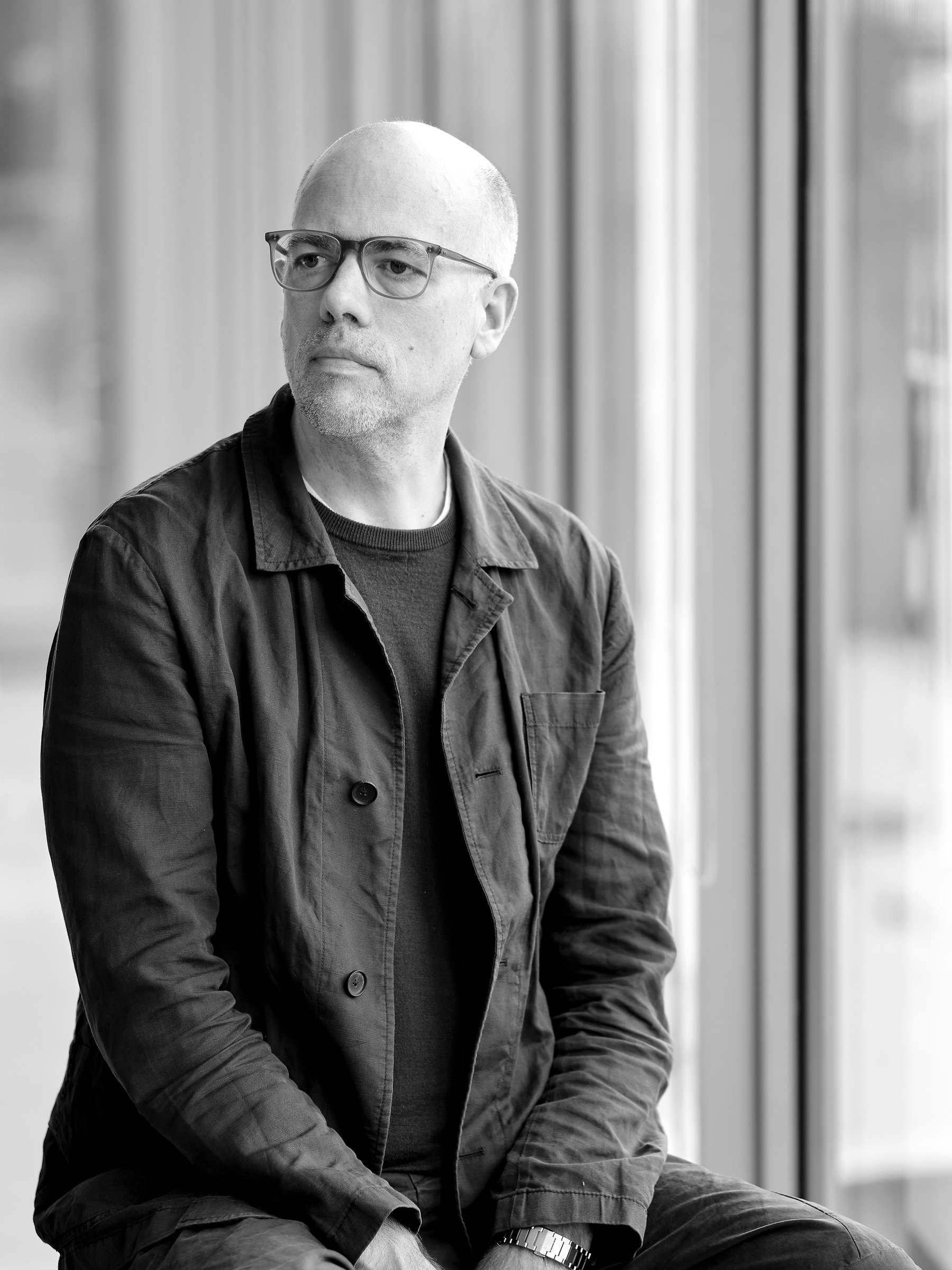
With Lukas Feireiss, Jan Bunge, and Tyen Masten
JB
Lukas, your work often explores the movement of ideas across disciplines, between art, architecture, design, and publishing. Could you begin by describing how this interest developed and how it informs your practice?
LF
For the last fifteen or sixteen years I have been exploring the borderlines between art, architecture, and design, both in theory and in practice. Space, in the widest sense of the word, is the red thread running through much of my work. Spaces and places in a metaphorical, philosophical, practical, and architectural sense. From inner space to outer space, so to speak. That is my particular obsession.
One could thereby describe the methodology driving this discussion as a collage or cut-up. I bring things together that do not necessarily belong together, whether topics, disciplines, or people. The basic principle of collage is that one plus one does not equal two. New narratives emerge. It becomes interesting where dominant narratives can be dissolved.
JB
Your work sits very close to architecture. How did that trajectory develop?
LF
I am not an architect. My graduate education was in Comparative Religious Studies and Philosophy in Berlin and Rome. However, I grew up in my mother’s architecture gallery from the age of three, so the world of architecture, or at least its representation through drawings and models, has always felt very natural to me.
In Amsterdam I ran a temporary master’s programme at the Sandberg Institute for two years with selected international students. The programme, Radical Cut-Up, explored collage and cut-up as contemporary forms of cultural production. The hypothesis behind the programme was deliberately provocative. There is no such thing as originality.

I do not believe in the artistic genius who invents the world out of thin air. Consciously or unconsciously, knowingly or unknowingly, we are influenced by countless things. Nothing exists outside context. What I do believe in is authenticity. I believe one can be completely authentic without being original.
If you look at the history of art or architecture, it is very rare that someone simply had an epiphany. It is usually difficult to identify who started an idea and when it was taken up by others. There are always many layers of appropriation taking place. With this in mind, you are freed from the creative anxiety of feeling that you have to come up with something completely new that nobody has thought of before.
Among many other influences, I was inspired by an essay by Jonathan Lethem, one of my favourite contemporary American writers, titled The Ecstasy of Influence. The title itself is a play on a well-known text by Harold Bloom called The Anxiety of Influence. Bloom described the anxiety writers often feel towards their literary idols. Imagine being a great admirer of Joyce or Dostoyevsky and wanting to create something comparable, yet being unable to write a single word. A classical case of writer’s block, caused by that anxiety of influence.
Lethem turns this idea upside down. He suggests that influence should be understood as an ecstasy rather than an anxiety. There is so much out there. Embrace it. Take it in. Copy Shakespeare, copy Bob Dylan, copy Picasso. They all copied themselves and others. It is part of the broader cultural narrative that we evolve on the shoulders of those who came before us.
This was something we tried to reflect on in the two-year master’s programme with a very diverse group of students from around the world. There were no architects involved. We had an industrial designer, several graphic designers, and people working in sculpture, photography, dance, music, production, performance, philosophy, and music journalism. Together we developed a rather liberated way of thinking about creativity, one that embraces what already exists rather than feeling guilty about it.

Etymologically speaking, the term “radical” comes from the Latin word for “root”. Radical Cut-Up therefore meant not only a fundamental cut-up, but also an approach that traces ideas back to their roots and origins. You can draw from anything you want, but you should remain aware of where it comes from. Try to follow ideas back to their sources so that you are not naively assembling things without understanding them. Even if you do work intuitively at first, afterwards you should try to understand where your inspirations came from. I think that awareness is important. The aim is not to foster ignorance, but rather a more conscious and liberated creative process.
We also did a great deal of publishing and organised several exhibitions. In that sense our experiments were always tested in reality.
TM
I had recently published an article reflecting on this question. With the enormous volume of information now circulating through media and the internet, designers are constantly absorbing references, ideas, and images. The challenge is not avoiding influence but becoming aware of it. Where it comes from, how it is processed, and how consciously it enters the work.
Too often we see designers copying without acknowledging it, or obscuring those references through language and presentation. For me, the question of honesty becomes important here. Being clear about the lineage of ideas rather than pretending they emerged in isolation.
How do you see intellectual property fitting within this culture of copying, remixing, and reuse?
LF
It’s a complex question with no satisfying answer. I believe that in the world we’re living in, where there is so much information, copying is almost unavoidable. But I believe in making sure you are aware of where you take your inspiration from, and then go wild with it.
It can harm the creative process if we focus too much on intellectual property. The problem behind it by now is monetary. Everything is calculated in monetary value. In music, for example, there’s a big debate around copyright. If I sample something, it can start a huge copyright fight about intellectual creative property, even though what I do with it may become a whole new thing. A completely new song. A completely new narrative.
As long as it’s credited, I think we should be safe. But that’s not the case legally speaking. So the legal issue here is far from resolved. In a way our understanding of intellectual property is still very twentieth century, or even nineteenth century, yet we’ve entered a new age. We have to find a new fluidity with it in one way or another.
I see a danger in saying “you can’t touch this” or “you can’t do that,” because otherwise everything becomes set in stone and nothing new evolves. The great developments, the moments of evolution, often happen when something that has existed for a long time is looked at again and done in a completely different way.
At the same time intellectual property is very important. There is a big difference between creative exchange and a situation where someone creates something interesting and a large company simply takes it and turns it into their own thing. That becomes a question of hierarchies and where power lies. So as I said, it is a complex question with many intersections that we have to reflect upon in each case.

TM
Absolutely. It’s probably too complex to take a clear position on it. The question of authorship and lineage is rarely straightforward. Sometimes we have to accept complexity as an answer.
JB
There is something there about the idea of the “root.” It connects very closely to open source thinking where, as long as you credit the authors and record where something comes from, it becomes possible to build on it.
In science this is completely normal. Research never stands on its own. It always builds on other people’s work. A scientist’s job is essentially to take existing findings, reassemble them, and hopefully discover something new or different.
But why do we struggle so much to apply the same logic to creative work?
Leaving intellectual property aside for a moment, if you think about all the studios around the world employing thousands of people trying to develop new ideas, how much easier would it be if we had a system that clearly showed where things come from and allowed you to adapt them, as long as people are credited?
Have you ever thought about the relationship between the scientific process and the creative process?
LF
Yeah, I’ve been thinking about what the core of science really is: experimentation. We sometimes forget that because we see science as something factual and given. But in reality it is a very long-term process of experimentation. The real scientific method is trial and error.
JB
The fundamentals of science, yes.
LF
Being based on trial and error basically means learning from mistakes. Failure and mistakes are an unavoidable part of scientific development. It’s what Stewart Brand, the founder of the Whole Earth Catalog, once called a “fiasco-by-fiasco approach to perfection.” So fail, fail again, fail better.
TM
There’s an old saying in architecture that if a building never leaks, you probably didn’t push it far enough.
Architecture evolves through experimentation. But we sometimes forget that we’re part of a much larger body of knowledge that is collectively testing ideas. Not only about buildings, but about space, materials, and how different kinds of information are brought together in design.
So why are we still so obsessed with originality? Why don’t we recycle more within design itself?
Is that something cultural, or is it something we are taught?
LF
Again there are many possible answers to this.
On the one hand, the idea of originality is definitely a phenomenon of Western culture.
The distinction between original and copy is very different if you look at Asian cultures, for example. In Chinese the term Shanzhai describes something that can actually become better than the original. A counterfeit product that surpasses it. Or if you look at traditional Japanese architecture, many temples are periodically rebuilt. The temples in Kyoto, for example, are not made from the original building materials anymore. Every piece of wood, every joint, is new. Yet the temple is still perceived as old.
The idea of restoration as we understand it in the West does exist, but the entire building can still be remade every few years. This approach is completely counterintuitive to Western notions of historical preservation. There is clearly a huge cultural factor in how authorship is understood.
Where does this come from? I’m not sure there is a single answer, but the idea of authorship and copyright takes us back to Gutenberg and the invention of the printing press. That was the first moment when printed copies of previously handwritten texts could be distributed widely across Europe.
Martin Luther was able to take great advantage of this by printing and circulating his pamphlets in large numbers. This also contributed to the development of national languages and eventually the emergence of nation states. In a way we are still influenced by the echoes of Gutenberg’s invention.

TM
For me a lot of it relates to the idea of synthesizing information. How do we synthesize things?
I’ve always found it quite liberating to draw from different places. Visual, social, cultural, economic. When you construct a project you’re assembling complex pieces of information and trying to synthesize them into an idea.
It’s not something anyone ever really taught me in school, but it’s something that feels increasingly important now that we’re dealing with such vast amounts of information.
When I first started studying the amount of material we were exposed to was much more limited. We would wait for books or magazines to arrive and then go through them looking for ideas. As designers those references can sometimes become stuck in your head in a negative way. They can almost debilitate you.
So flipping that logic is really interesting to me. Instead of seeing influence as a constraint, it becomes an opportunity.
What was the response of your students to these ideas?
LF
Actually today I had lunch with two former students who graduated from the Radical Cut-Up program. They told me that one of the most important aspects of those two years was the constant critical discourse happening within the group.
Of course the students who applied already felt connected to the ideas in some way, but there was also definitely a generational dimension to it. The average age in the program was around twenty-seven. This is a generation that instinctively turns to Google to find references and start exploring ideas.
It’s a legitimate tool. It can be used superficially, but it can also be used to dig deeper and understand the narrative that is opening up. The interesting thing is that when you combine references and recycle ideas, it’s not simply about using something that already exists.
You create a new storyline. That’s where the power lies.
It’s not just a rip-off. It adds a twist, shifts the perspective, and completely recontextualizes things.
TM
I’ve found that it also becomes a tool for learning. Once those references are identified and you dig deeper into them, it becomes a way of processing information more critically.
LF
Absolutely. This is a bit cheesy, but I love the quote: “Creativity is intelligence having fun.” Because it’s so true. That moment when you’re intellectually teased, when an idea starts sparking and you’re having fun with it. That’s when the best creative outputs happen.
Along with this approach comes a kind of flat hierarchy of knowledge. Meaning Einstein is not necessarily more valid than, say, a commercial in a yellow press newspaper. Both are cultural outputs. We should treat them with equal attention and seriousness in order to play with them.
When you give everything the same level of attention and try to understand where it comes from and the context it appears in, you can start weaving things together to create something new. There is a lot of power in that.

JB
It’s a discourse, as you said. That’s the beautiful thing.
Too often the opposite happens. People don’t talk about their influences because they want to hide them. But the moment you engage with these things seriously, and bring them into dialogue with the people you are creating with, you begin to discover things you weren’t even looking for.
It becomes a process of putting ideas on the table, exploring them, and trying things out.
I think what’s often missing is precisely that discourse. It’s really interesting to hear that this was one of the things the students valued most in the course. Too often we don’t create the conditions for people to go deeper and have that kind of exchange. If we did it more often, we would discover things we’re currently missing because we simply aren’t engaging enough.
LF
Speaking of dialogue, I had two students who met during the course and decided to start an artistic career together. They gave up their individual names and created a shared alter ego. They only work as a team now. They even did their master’s graduation together. It was the best possible outcome you could imagine.
TM
I think designers often disregard information that enters the creative process because it doesn’t fit the image they already have of what the project should be.
Client feedback, for example, or other inputs that require change, can be ignored because there is a fixed idea about what the design needs to be. But if you open that up, it allows many other possibilities to enter the process and actually enrich the design.
You often hear architects say: the client wants this, but it goes against everything the design believes in. Which is a strange position to take. Why should a design be so inflexible that it can’t absorb new information? It’s something we see quite often in architectural practice.
LF
I think we should improvise more, in the musical sense of improvisation. Think of jazz. Miles Davis never scripted every note he played. He followed the flow.
And once you leave conventional boundaries and enter that dangerous zone of improvisation, where you’re no longer strictly following the rules, that’s usually where the magic happens.
TM
If you’re taking this eclectic approach of reuse and displacement in designing spaces, how does that change the way we think about the spaces we live in? How does it enrich them?
LF
I think there is both a long-term and a short-term perspective.
Starting with the long term, I would refer again to Stewart Brand, whom I mentioned earlier. Apart from his well-known work on the Whole Earth Catalog, he also made an incredibly inspiring BBC series called How Buildings Learn. The central idea of the series is that buildings are rarely used in the way they were originally planned.
Buildings learn, and inhabitants learn. There is a beautiful series of photographs showing how tenants of Le Corbusier’s buildings have altered and adapted the original architectural ideas through everyday use. Good architecture should allow for those kinds of changes in one way or another.
%20Schnepp%20Renou%20%E2%80%93%202020.jpg)
If you think about it, it is actually very rare that a building maintains the same function for centuries, or even decades. Post offices, for example, were once central institutions in cities, but they are far less significant today. So the question becomes: how do buildings change, and how can architecture remain flexible enough to accommodate that? I think that flexibility is inherent to architecture.
In the short term, and something more directly applicable to the design process, it’s about allowing for a degree of uncertainty from the beginning. Of course you cannot simply improvise everything. You have a client, and you need a roof that doesn’t leak. There are certain things that have to work.
But even within that, you can leave space for surprise by keeping certain areas undefined or open to interpretation. That could mean leaving part of a building flexible, or allowing a space to evolve through public use. When that happens, unintended possibilities can emerge.
JB
I think that is already starting to happen more and more. We can now monitor the performance of space and how it is actually used through technologies like IoT sensors.
You could imagine a scenario where projects are never truly finished and the architect remains involved over time.
If we extend what you are saying further, architecture could be approached more like software. An iterative process. Your operating system is updated every year, built on top of what already exists, based on user feedback and changes in society.
We might be entering a moment where a new generation of architects and engineers begins to think this way. Instead of leaving a few spaces open, we might actually begin designing buildings specifically for change.
Today the typical model is that the architect finishes the building and the job is done. But we could imagine a future where the architect returns periodically to observe how the space is used and allows it to evolve.

LF
Yes, although it is also a budgetary issue. The architect’s job usually stops once the building is completed and opened. There is rarely a budget for follow-up.
As a result, very few architects actually learn from their failures because they never return to observe them. In that sense, the idea of continuously evolving space can sometimes sound like a kind of utopian romanticism, almost like Constant’s New Babylon.
But there is some truth in it. Architecture provides the framework, or to use your programming metaphor, the hardware. What you quickly realise, however, is that the software ultimately defines how the space functions.
Ideally this understanding would already be incorporated into the design process. Imagine if for every project a certain percentage of the budget were reserved for the “software”, the social programming of the future building.
There are many examples of incredible venues where everything appears perfectly designed, but because there is no budget for programming or activation, the spaces remain empty.
A provocative idea might be to expand the architect’s role and budget so that they are required to return to a project over time.
TM
We’ve always found the question of follow-up very difficult. Often buildings are driven by briefs that focus almost entirely on the moment of delivery.But if you begin to introduce the idea of legacy into the brief, looking twenty, thirty, forty, even fifty years ahead, it starts to raise interesting questions for the client.
Of course some clients have no interest in that and simply want to complete the project and move on. But with the right clients you can begin to develop a longer vision together.
It can take time for a building to mature, so I think there is something important in trying to introduce that perspective from the beginning.
LF
That’s the challenge for every designer, in any field: expanding the brief.
If you have a good client it becomes possible. I remember Thom Mayne once saying there is no such thing as a good architect, only a good client.
It’s a two-sided relationship. Sometimes you have to learn together with the client, or even educate them, to expand the brief beyond its initial limits and open up more possibilities.
I think designers have a responsibility to challenge the brief and, whenever possible, shake up the system.
JB
Yes. We really need to rethink these processes. The way we incentivise projects, the way we manage risk, the way we organise design and construction. All of it needs to be reconsidered.
Interview conducted by Jan Bunge as part of the Copy/Paste series.
Edited and published by Tyen Masten as part of the Alternative Futures series.
%20Roman%20Goebel_2020_colour.jpg)
Contact
First Phase
First Phase diagnostic.